

Word Mosaic
Fugo Games
Word Mosaic is the kind of word game I can open without preparing myself for a long session. Its central idea is easy to understand: I place letter tiles into the correct squares until a mosaic puzzle is complete. That simple combination gives it a calmer identity than a typical timed spelling game, because the satisfaction comes from fitting pieces into a finished pattern rather than racing through a list of words.
After spending time with it, I see the game as a quiet, focused option for short breaks. It is free to start, aimed at Everyone, and developed by Fugo Games. The store page presents it as a word title, but the experience also borrows from visual puzzle games: I am not only thinking about vocabulary, but also watching a board gradually become complete. The strongest part of Word Mosaic is the connection between language and visual order.
The first impression is deliberately approachable. There is no complicated rule set to memorize, and the basic action is clear almost immediately. I look at the available tiles, consider where they might belong, and work toward a completed arrangement. That makes the game suitable for someone who enjoys word puzzles but does not necessarily want a traditional crossword, a fast anagram challenge, or a competitive leaderboard-driven experience.
A word puzzle built around visual calm
The opening experience and the pace of discovery
What I like about the opening concept is that it gives every move a visible purpose. In many word games, solving a word simply removes it from a list or adds points to a total. Here, placing a tile contributes to a larger image-like structure. Even when the vocabulary task is modest, the board gives me a reason to keep going because I can see the unfinished pattern becoming more coherent.
This also changes how I handle mistakes. I am less inclined to rush through a possible answer just to maintain momentum. A misplaced tile can disturb the arrangement, so I naturally pause and inspect the surrounding squares. That small hesitation is important: it makes the game feel more like arranging a puzzle than tapping through an endless vocabulary exercise.
Related News






For an everyday example, I could play it while waiting for an appointment or during a short evening break. I would not need to remember a complex storyline or commit to a long match. A few minutes of attention is enough to engage with the board, and the visual progress gives the session a satisfying endpoint. This makes it a better fit for fragmented free time than word games that only feel rewarding after a lengthy run.
Who will understand the appeal quickly
I would recommend it first to players who like word puzzles with a tactile, spatial twist. If you enjoy arranging pieces, completing patterns, and solving at a measured pace, the mosaic framing gives familiar letter-based play a pleasant change of emphasis. It can also work for casual family play, especially because the content rating is Everyone and the main idea is easy to explain without a tutorial speech.
On the other hand, players who want deep vocabulary competition may find the presentation too gentle. This is not the game I would choose when I want a highly pressurized spelling duel, a serious dictionary workout, or a social challenge against friends. Its appeal depends on enjoying the process of completion. If your favorite part of a word game is speed, score chasing, or discovering obscure answers, a more traditional alternative may suit you better.
Gallery
How the visual language supports the setting
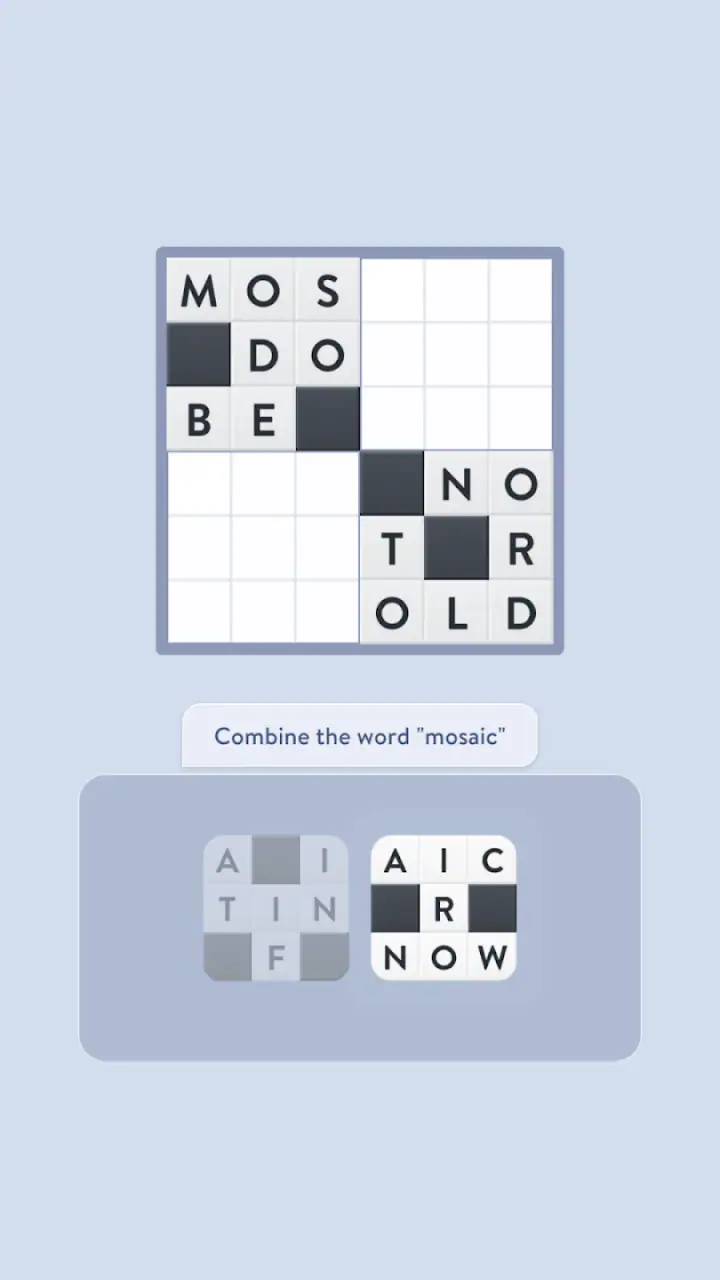
The word “mosaic” is more than a label here because it describes the relationship between the board and the task. The setting is communicated through arrangement and completion rather than through a large narrative world. I am not being asked to follow a complicated plot; instead, the game creates a small space where letters become pieces of a composed image.
That restraint helps the mood stay coherent. The visual idea does not compete with the word-solving objective. Each tile remains functional, and the growing pattern reinforces the reason I am solving the puzzle. In a weaker design, decorative artwork could make the board harder to read or turn the game into a collection of unrelated screens. Word Mosaic works best when the artwork feels like an extension of the puzzle rather than a distraction from it.
There is also a useful psychological effect in the incomplete board. An unfinished mosaic creates a gentle sense of tension, but not the aggressive pressure associated with a countdown. I want to finish because the composition looks incomplete. That is a softer form of motivation, and it suits players who prefer concentration over adrenaline.
Sound, silence, and the rhythm of a session
Sound matters in a game like this because the mechanics are based on repeated, deliberate placement. Audio should support the rhythm of choosing, positioning, and checking rather than overwhelm it. My ideal way to approach Word Mosaic is as a focused activity, where visual feedback carries most of the communication and the sound layer remains supportive.
The important point is pacing. A word game can become tiring when every move is treated like an event, with constant interruptions or exaggerated reactions. The mosaic structure calls for a more measured rhythm. I want enough feedback to understand that a tile has been accepted or that a board is progressing, but I also want space to think about the next placement.
This makes the game especially suitable for low-energy moments. I can imagine using it after work when I want something interactive but not emotionally demanding. It gives my attention a narrow target: identify the useful word relationship, place the tile, and observe the board. That loop is more restorative than a frantic spelling game, although players who need a strong soundtrack or dramatic audio identity may find the atmosphere understated.
A practical tip is to treat the sound as part of your preferred environment rather than as the main attraction. If I am playing in a quiet room, the visual structure can carry the experience by itself. If I am commuting or surrounded by background noise, I would focus more on the board than on the audio mood. The game’s core remains readable because the puzzle is visual and spatial at heart.
Why the mechanics and presentation fit together
The central mechanic has a natural relationship with the art direction. Letter tiles are not merely answer buttons; they are components in a larger arrangement. Every correct placement therefore does two jobs at once: it advances the word puzzle and improves the visual composition. That dual feedback is the game’s clearest design strength.
I also appreciate that the concept avoids unnecessary complexity. The store summary describes placing tiles into the correct squares to complete the mosaic puzzle, and that description captures the main action without hiding it behind a larger system. For casual players, this directness is valuable. I can understand what I am doing, and the game does not need a complicated narrative excuse for the puzzle to exist.
There is a trade-off, though. A focused mechanic can feel repetitive if the surrounding presentation does not continue to provide a sense of progress. The visual completion must remain meaningful, because the basic placement action alone is intentionally simple. Players should approach Word Mosaic expecting refinement and concentration, not a constantly expanding set of mechanics.
Useful ways to play more thoughtfully
One useful habit is to scan the whole board before committing to the first obvious tile. In a standard word game, finding a valid answer may be enough. Here, the correct location matters as much as the word relationship, so I get better results by checking neighboring squares and looking for patterns that constrain the choice. This turns the game from simple recognition into a small exercise in spatial deduction.
A second tip is to use the visible mosaic as a memory aid. When several tiles seem plausible, I pay attention to the shape of the unfinished area and the positions already completed. The board can help me remember what remains, reducing the need to hold every possibility in my head. This is a subtle advantage over a plain list-based word puzzle, where progress is often represented only by text or a score.
A third insight is that the game rewards stopping at a natural point. Because the mood is built around completion, I do not need to force a long session. Finishing a board or reaching a visually satisfying stage gives the experience a clean pause. That makes it easier to fit into a daily routine than games designed around endless rounds, though players who prefer a constant stream of new challenges may want a more expansive word-game format.
Free access and the question of spending
Word Mosaic is free to download and play, with optional in-app purchases priced from $1.99 to $19.99 per item. That means I can try the central experience without paying first, which is important for a game whose appeal depends heavily on whether the calm mosaic presentation matches my taste.
I would approach the purchase options as convenience choices rather than as a reason to begin playing. The free entry point lets me decide whether the tile placement, vocabulary level, and pacing are enjoyable enough to keep. If I dislike slow visual completion or want more competitive pressure, spending money would not solve that basic mismatch. The better decision is to test the natural rhythm of the game first.
For parents or anyone choosing a casual title for a shared device, the Everyone rating makes the game easier to consider from a content perspective. The minimum operating system is Android 8.0, so compatibility should be checked before installation on an older phone or tablet. The current version is 1.7.1, which is useful to know when comparing the experience on different devices or troubleshooting an installation.
How it compares with familiar word-game alternatives
Compared with a crossword, Word Mosaic feels less dependent on reading clues and more focused on fitting language into a visual structure. A crossword is often about interpreting definitions and managing intersecting answers. Here, the mosaic board gives the puzzle a more object-like quality: I am arranging pieces toward a complete composition.
Compared with an anagram game, it is also less about producing as many words as possible under pressure. Anagram games often reward speed and quantity, while this title gives more importance to placement and gradual completion. That makes it a good alternative for players who enjoy vocabulary but find rapid-fire word lists exhausting.
Compared with a word search, the experience appears more deliberate. Word searches are usually about scanning a dense grid for hidden sequences. Word Mosaic instead asks me to think about how tiles belong in designated squares. The distinction is small in description but noticeable in play: the board is not just something to inspect; it is something I actively assemble.
The compromise is that none of these comparisons should create expectations of a deep narrative adventure or a highly competitive puzzle platform. Its identity is narrower and, in my view, more consistent. The game is strongest when I want a visually guided word activity that stays calm and understandable.
Where the experience may lose momentum
The same simplicity that makes the game welcoming can limit its appeal over time. If I need constant novelty, complex progression, or a powerful sense of personal improvement, the mosaic format may eventually feel restrained. The game’s atmosphere is intentionally controlled, so it does not provide the same rush as a timed challenge or the same intellectual density as a difficult crossword.
There is also a potential friction point in the balance between visual polish and puzzle depth. If the board is attractive but the word decisions remain too obvious, I may admire the presentation without feeling fully challenged. Conversely, if the vocabulary becomes difficult without enough visual guidance, the calm mood could turn into frustration. The best experience comes when the art direction helps me stay oriented while the word problem still requires attention.
I would also skip it if my main reason for downloading a word game is social competition. The verified store details identify it as a single game experience from Fugo Games, but they do not make competition the reason to choose it. I would select a multiplayer word title instead if I wanted direct matches, shared scores, or the pressure of playing against another person in real time.
Device fit and a realistic daily routine
Because the main interaction is placing tiles into squares, I would prefer playing on a screen where the board is easy to inspect. A larger phone or tablet could make the visual relationship between the tiles and the mosaic more comfortable, especially during longer sessions. On a small display, the game may still be convenient for quick breaks, but I would be more careful about misreading a square or tapping too quickly.
My most realistic routine would be a short session in the morning with coffee, a few minutes during a commute when I am seated, or a wind-down activity before bed. I would not use it as background entertainment while doing something else, because the satisfaction comes from noticing relationships between letters and positions. It asks for light concentration, not complete mental absence.
That makes it useful for people who want a screen activity with a clear boundary. I can begin with one unfinished arrangement and stop after making meaningful progress. It is less suitable for someone looking for an infinite feed of stimulation, but that limitation is also part of its charm.
My atmosphere verdict
Word Mosaic succeeds when its visual language, sound, and mechanics are considered as one small, coherent package. The mosaic setting gives the word puzzle a recognizable mood, the measured rhythm supports concentration, and the tile-placement mechanic makes progress visible. I never feel that the artwork is merely sitting beside the game; the board itself is where the atmosphere and the challenge meet.
Its biggest strength is its clarity. I know what I am trying to accomplish, and each correct move improves both the puzzle state and the appearance of the board. That is a satisfying loop for casual players, families, and anyone who prefers a calmer alternative to timed spelling games.
Its main limitation is equally clear: this is not the right choice for players who need intense competition, elaborate storytelling, or a deep collection of constantly changing systems. The experience depends on enjoying repetition with purpose. If arranging tiles toward a finished visual pattern sounds relaxing rather than restrictive, it has a strong chance of fitting your routine.
The game has earned an average rating of 4.8 from around 12 thousand ratings, with over 100 thousand installs, which suggests that its accessible idea is connecting with a sizeable audience. I would not use those figures as a substitute for personal taste, but they match my overall impression: Word Mosaic is a focused word puzzle for people who want completion to feel visual, orderly, and unhurried.
My final recommendation is to try the free version when you want a gentle puzzle break, especially if ordinary word games feel too frantic or too text-heavy. Give it a fair test by playing slowly, studying the board before placing uncertain tiles, and noticing how the unfinished mosaic guides your decisions. If that rhythm feels rewarding, this is an easy game to keep nearby. If you are searching for speed, rivalry, or demanding vocabulary practice, I would choose a different word-game style instead.
FAQs for Word Mosaic
What is Word Mosaic and how does the game work?
Word Mosaic is a relaxing word puzzle game in which you connect, arrange, or combine letters to discover hidden words and complete colorful mosaic-style boards. Each level generally starts with a group of available letters and a word objective. As you progress, puzzles become more challenging, introducing longer words, less obvious combinations, and additional goals that test both vocabulary and observation skills.
Is Word Mosaic suitable for beginners and children?
Yes, Word Mosaic is generally easy to understand for beginners because its core gameplay is based on familiar word-search and letter-combination mechanics. The early stages provide a gentle introduction, while later puzzles offer more difficulty for experienced players. Parents should still check the app’s age rating and language settings, especially if children will play, since puzzle vocabulary and advertising may vary.
Does Word Mosaic require an internet connection to play?
Many Word Mosaic levels can usually be played without a constant internet connection once the game has been installed and its necessary content is available. However, an internet connection may be required for advertisements, cloud synchronization, new content, rewards, or certain online features. If you plan to play while traveling, it is best to open the game beforehand and confirm which features remain accessible offline.
Are there hints, boosters, or in-app purchases in Word Mosaic?
Word Mosaic may include optional hints or assistance tools for difficult puzzles, often earned through gameplay or obtained through the game’s reward system. Depending on the version and platform, some resources can also be purchased through in-app transactions. You can normally progress without spending money, but using hints frequently may slow free progress. Review purchase settings carefully if children use the device.
What are the main advantages and disadvantages of playing Word Mosaic?
The main advantages of Word Mosaic are its simple controls, relaxing pace, short levels, and vocabulary-focused gameplay, making it suitable for quick sessions or casual daily play. It can also encourage spelling and word recognition. Possible disadvantages include repetitive mechanics after extended play, increasingly difficult words, advertisements, and limited variety if you prefer fast action or highly competitive multiplayer games.
Pros
- Relaxing gameplay suitable for short sessions or longer play.
- Word puzzles help build vocabulary and encourage careful observation.
- Clean mosaic-style visuals make the board easy to follow.
- Gradual difficulty provides a comfortable challenge for casual players.
- Offline play makes it convenient when an internet connection is unavailable.
Cons
- Some puzzles may feel repetitive after extended play.
- Hints can reduce the challenge and may be limited or ad-supported.
- Later levels may rely on obscure or less familiar words.
- Ads can interrupt the experience
- especially between puzzle rounds.
- The game offers limited variety beyond its core word-matching mechanic.


